Free printable learning activities are most useful when they feel like play, take less than ten minutes to start, and practice one clear skill at a time. Quick answer: choose printables that match your child's current level, keep supplies simple, and rotate between reading, math, writing, and hands-on discovery. A worksheet pile can feel overwhelming, but a small folder of well-chosen activities can rescue a rainy afternoon, fill a quiet morning, or support homeschool practice without buying a full curriculum.
This post contains affiliate links. We may earn a small commission at no extra cost to you.The trick is not finding more pages. It is choosing the right pages and using them in a way kids actually enjoy.
Start With One Skill, Not a Giant Packet
Big printable bundles look impressive, but kids often do better with one focused activity. For preschoolers, that might be matching uppercase and lowercase letters. For early elementary kids, it might be ten addition facts, a short reading response, or a simple map activity.
Before printing, ask: "What will this help my child practice today?" If the answer is fuzzy, skip it. A five-minute rhyming game beats a twenty-page packet that leaves everyone cranky.
For an easy setup, keep a small bin with crayons, pencils, glue sticks, safety scissors, and a few sheet protectors. Dry-erase sleeves are especially helpful because kids can reuse tracing pages, number lines, and sight-word practice sheets. A basic set of dry erase pockets for worksheets can make free printables feel sturdier and cut down on paper waste.
Build a Simple Weekly Printable Rotation
A good printable rhythm gives kids variety without making parents plan a miniature school day. Try this rotation:
- Monday: letter sounds, sight words, or read-and-draw pages
- Tuesday: counting, addition, subtraction, patterns, or graphing
- Wednesday: handwriting, story prompts, or labeling pictures
- Thursday: science observation, nature journal, or simple experiment sheet
- Friday: coloring, cutting, puzzles, mazes, or a review game
You do not need to complete every day. The rotation is just a menu. If your child loves mazes, use a maze to practice letter recognition. If they are into animals, print a habitat sorting page. Interest is not a bonus; it is the engine that keeps practice moving.
For more low-cost planning ideas, our guide to free homeschool resources that are actually good pairs well with printable activities.
Make Printables Hands-On
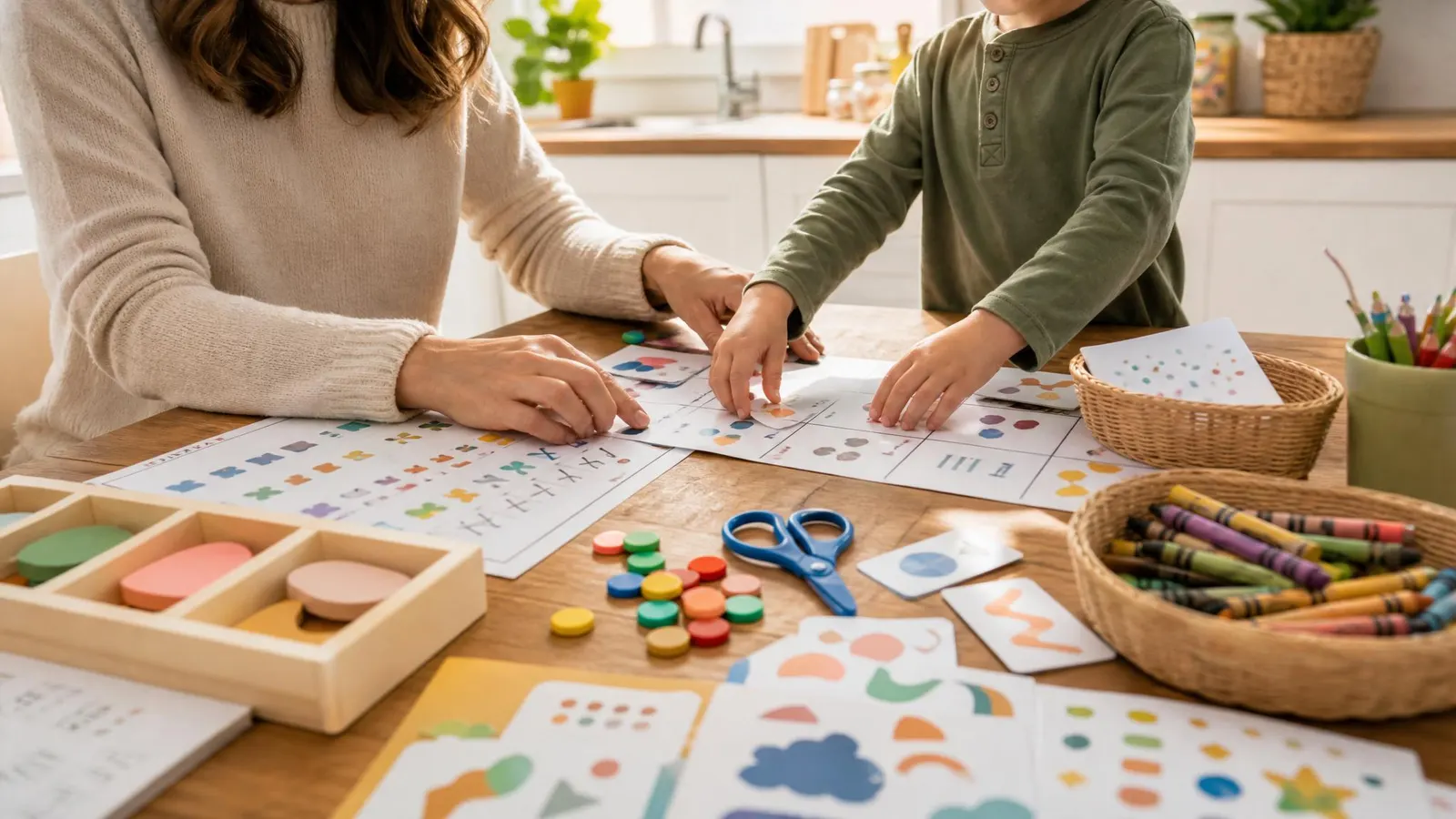
The fastest way to improve a printable is to add a small object kids can move. Instead of circling answers, let your child cover them with buttons, cereal pieces, mini erasers, or counting bears. Instead of writing every word, ask them to build one word with magnetic letters first.
This is especially useful for younger kids who are still building fine motor stamina. A child may understand the math perfectly but get tired from writing numerals. In that case, use the printable as the game board and let manipulatives do some of the work. A simple math manipulatives set can stretch dozens of free pages into more active learning.
You can also laminate favorite pages or slide them into reusable sleeves. Tracing lines, ten frames, alphabet mats, and chore charts all work well this way.
Where to Find Quality Free Printables
Not every free printable is worth the ink. Look for pages with clear instructions, age-appropriate spacing, and one main task. Avoid cluttered designs with tiny boxes, busy backgrounds, or too many directions.
Reliable starting points include library websites, museum education pages, and teacher-created resources. For reading practice, Reading Rockets has parent-friendly literacy guidance that can help you choose activities with a real purpose behind them.
When you save a printable, name the file clearly on your computer or keep a physical folder by category: reading, math, writing, science, and art. That tiny bit of organization prevents the dreaded "I know I printed something for this" scramble.
Keep It Light and Stop Early
Printable activities should not become a daily battle. Set a timer for 10 to 15 minutes, celebrate effort, and stop before your child melts down. If a page is too hard, turn it into a shared activity. You can do the first problem, your child can do the next, and a stuffed animal can "choose" the final answer.
For kids who resist worksheets, try a clipboard, colored pencils, or a special kids clipboard storage case. Sometimes changing the format is enough to make the same activity feel fresh.
The goal is steady practice, not perfect pages. A half-finished printable that sparked a good conversation is still a win.
FAQ
What age are free printable learning activities best for?
They work well from preschool through elementary school, as long as the activity matches the child's level. Preschoolers usually need short, hands-on pages with coloring, matching, tracing, and sorting. Older kids can handle word problems, reading responses, maps, and simple research organizers.
How many printable activities should kids do per day?
One or two short activities is enough for most families. For young kids, ten focused minutes can be more productive than a long stack of pages. If your child asks for more, keep going, but do not treat volume as the goal.
Are printable worksheets as good as hands-on learning?
Printables are best when they support hands-on learning, not replace it. Use them as recording sheets, game boards, sorting mats, or prompts for conversation. Kids learn more when they can touch, move, explain, and connect the page to real life.