Is it going to rain today? Why is it so windy? Kids have a million questions about the weather, and what better way to answer them than with a hands-on science experiment? You can explore complex weather concepts right from your kitchen table using simple items you already have.
This post contains affiliate links. We may earn a small commission at no extra cost to you. Quick answer: To teach kids about weather, try simple, visual experiments. You can make a cloud in a jar with warm water and ice, build a rain gauge from a plastic bottle to measure rainfall, or create a vortex in a bottle to simulate a tornado. These activities make abstract weather concepts tangible and exciting for young learners.Getting your child involved in these mini-projects helps them practice observation, measurement, and critical thinking. Let's turn your little meteorologist loose on these fun and easy weather experiments!
1. Make a Cloud in a Jar
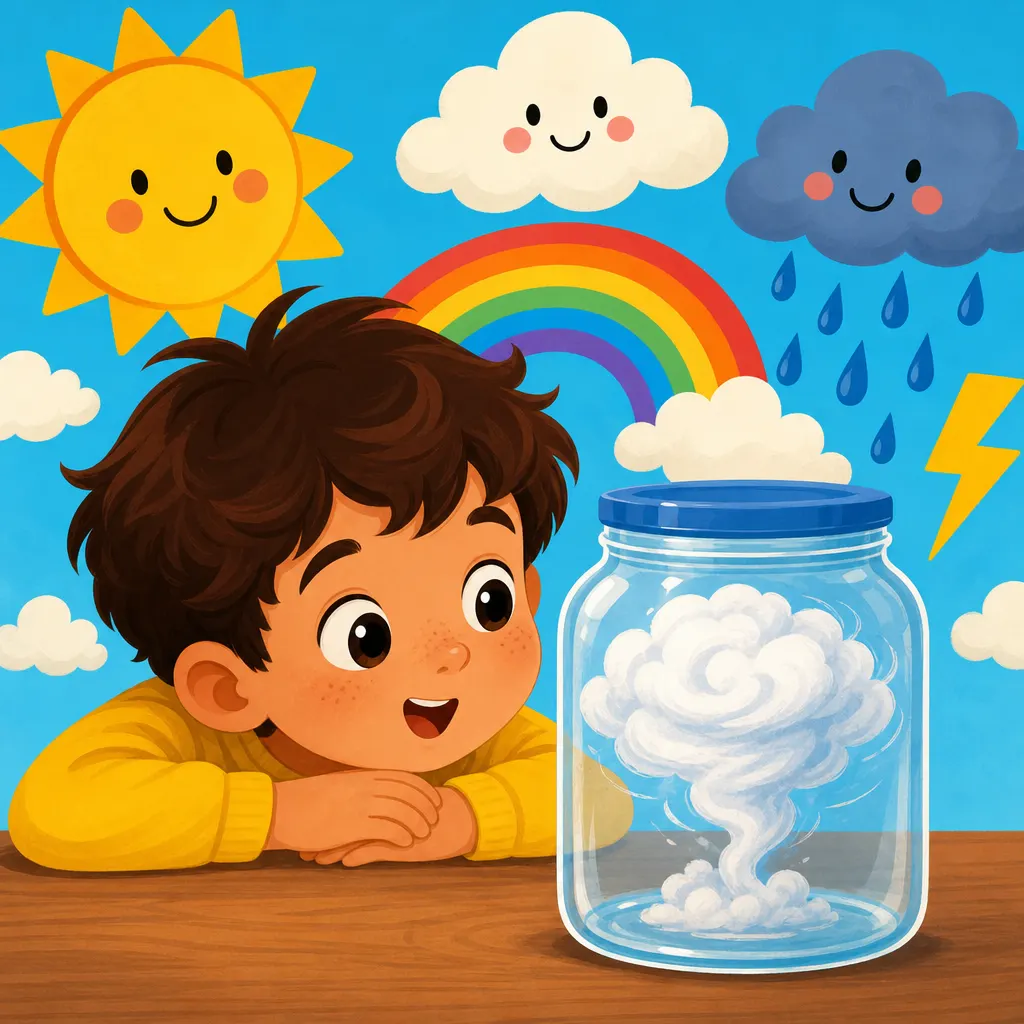
This is the quintessential weather experiment, and it's a jaw-dropper every time. It perfectly demonstrates how clouds form when warm, moist air cools down.
What You'll Need
- A clear glass jar with a lid
- Hot water (not boiling)
- Ice cubes
- An aerosol spray (like hairspray)
The Experiment
Pour about an inch of hot water into the jar. Swirl it around to warm the sides. Turn the lid upside down and place several ice cubes on top of it. Quickly, give a short spritz of hairspray into the jar and immediately place the lid (with ice) on top. Watch closely! You will see a cloud form inside the jar. The hairspray provides particles for the water vapor to condense onto, just like dust and pollen do in the atmosphere.
2. Build a DIY Rain Gauge
This simple project helps kids understand precipitation and introduces them to the basics of data collection as they measure rainfall over time.
What You'll Need
- A 2-liter plastic bottle
- Scissors or a craft knife (adult use only)
- A ruler
- Permanent marker
- Pebbles or marbles
The Experiment
Have an adult carefully cut the top third of the plastic bottle off. Place a handful of pebbles in the bottom of the bottle to weigh it down so it doesn't tip over. Invert the top part you cut off and place it inside the bottle to act as a funnel. Use a ruler and permanent marker to draw measurement lines on the side of the bottle, starting from the bottom. Place your new rain gauge outside in an open area and start tracking the rain! For more advanced tracking, you can compare your findings with a real digital weather station for kids.
3. Create a Tornado in a Bottle
The swirling vortex you can create with two bottles is a safe and mesmerizing way to explain how tornadoes form from rotating air columns.
What You'll Need
- Two 2-liter plastic bottles (empty)
- Water
- A tornado tube connector or duct tape
- Optional: glitter or small beads
The Experiment
Fill one bottle about two-thirds full of water. Add a pinch of glitter to make the vortex easier to see. Attach the second, empty bottle to the first using a plastic tornado tube connector (the easiest and most reliable method) or by securely taping the mouths together. Flip the bottles over so the full one is on top, give it a firm circular swirl, and place it on a table. A beautiful, swirling vortex will form as the water drains into the bottom bottle. This is a great way to start a conversation about wind and air pressure.
4. Measure Wind with a Homemade Anemometer
An anemometer is a tool meteorologists use to measure wind speed. You can make a simple version to see how fast the wind is blowing in your backyard.
What You'll Need
- 5 small paper cups (like Dixie cups)
- 2 straws
- A pin
- A pencil with an eraser
- A stapler
The Experiment
Take one cup and punch a hole in the side of the other four cups. Push the two straws through the center cup to form a cross. Staple the other four cups to the ends of the straws, making sure they all face the same direction (e.g., clockwise). Push the pin through the center of the straws and into the pencil's eraser. This is your axis. Take it outside and watch it spin! While it won't give you miles per hour, you can count the rotations per minute to compare wind speed on different days. It’s a foundational concept also explored in many STEM building kits for young engineers. And for more great at-home learning ideas, check out our post on easy hands-on science experiments.
For official weather information and more learning resources, the National Weather Service is a fantastic resource for families.
FAQ
H3: What is the simplest weather activity for a preschooler?
Making a cloud in a jar is visually impressive and easy for a young child to observe. While they won't grasp the full science, the "magic" of creating a cloud is a powerful and memorable introduction to weather concepts.
H3: How can I explain what wind is to a child?
Use analogies they can understand. Explain that wind is just air moving from one place to another, like when you blow out a birthday candle. You can demonstrate this by blowing on their hand or using a fan. The homemade anemometer helps make this invisible force visible.
H3: Where is the best place to put our rain gauge?
Find a spot in your yard that is open and away from trees, roofs, or anything that could block the rain or cause extra water to drip into it. This ensures you are only measuring the rain that falls directly from the sky.