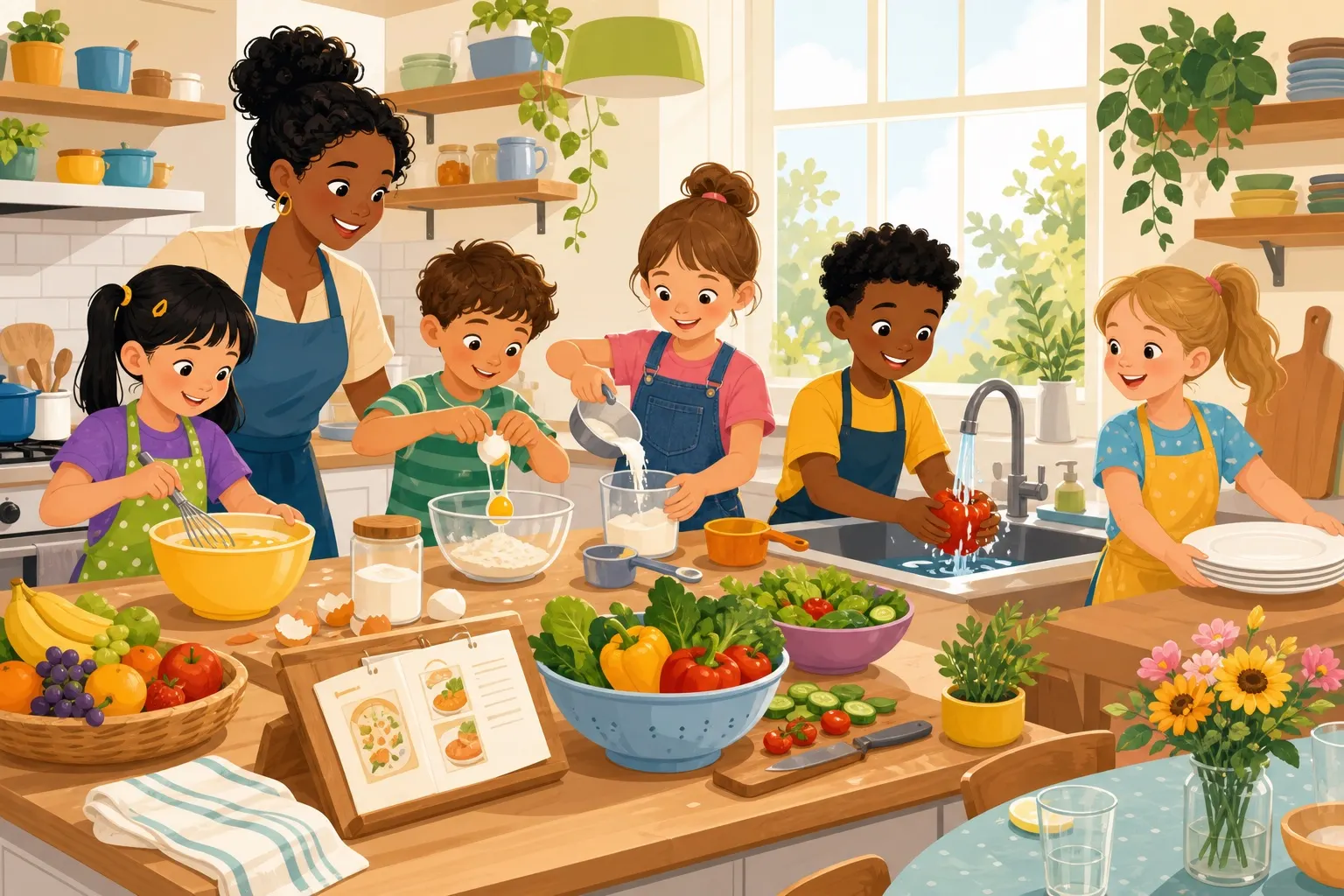
Getting your kids into the kitchen is one of the best things you can do — and not just because a future helper with the dishes sounds amazing. Cooking with kids genuinely builds confidence, math skills, reading comprehension, and fine motor coordination, all while making memories neither of you will forget.
This post contains affiliate links. We may earn a small commission at no extra cost to you. TL;DR: Cooking with kids doesn't have to be chaotic. Start with age-appropriate tasks (toddlers can wash and pour; big kids can measure and stir), choose simple 5-ingredient recipes, and focus on the process over perfection. A little flour on the floor is a small price to pay for the skills they're building.Yes, it will take longer than cooking alone. Yes, there will be spills. But when your kid proudly announces at the dinner table, "I made this!" — trust us, it's completely worth it.
Why Cooking Is One of the Best Learning Activities
You might not think of the kitchen as a classroom, but it really is. Every recipe is a reading exercise. Every cup of rice is a math lesson. Every kneaded dough is a fine motor workout.
The Skills That Get Sneaky-Educated
Here's a quick rundown of what's actually happening when your child stirs that pancake batter:
- Math: Measuring ½ cup or doubling a recipe is fractions in action.
- Reading: Following a recipe builds sequencing and comprehension.
- Science: Watching bread rise or butter melt is chemistry they can see (and eat).
- Fine motor skills: Pouring, stirring, and spreading are all great for hand strength and coordination — skills we talk about more in our guide to fine motor skill activities for toddlers.
According to a study highlighted by Harvard T.H. Chan School of Public Health, kids who are involved in food preparation are more likely to eat a wider variety of foods and develop healthier eating habits overall. That's a pretty delicious bonus.
Matching Kitchen Tasks to Your Child's Age
The number one rule of cooking with kids? Meet them where they are. A two-year-old and a seven-year-old have very different skill levels, and setting realistic expectations makes the whole experience more fun for everyone.
A Simple Age Guide
- Ages 2–3: Washing vegetables, tearing lettuce, pouring pre-measured ingredients, stirring with supervision.
- Ages 4–5: Measuring dry ingredients, mashing bananas, spreading with a butter knife, pressing cookie cutters.
- Ages 6–8: Cracking eggs, peeling (with a safe peeler), reading simple recipes, operating a microwave with guidance.
- Ages 9+: Using a stovetop with direct supervision, chopping soft foods with a proper knife, following a full recipe independently.
A good kid-safe knife set makes a huge difference for older kids. Nylon or plastic-bladed options let them learn proper cutting technique without the risk.
3 Easy Recipes Perfect for Cooking Together
These recipes are chosen because they have a small number of steps, forgiving measurements, and at least one job for little hands at every stage.
Recipe 1: No-Bake Energy Balls
Mix oats, honey, peanut butter, and mini chocolate chips. Roll into balls. Refrigerate for 30 minutes. That's it. Kids LOVE the rolling step, and there's zero oven time. These also make a genuinely great after-school snack.
Recipe 2: Homemade Pizza
Use a store-bought flatbread or pre-made dough as the base. Set out small bowls of sauce, cheese, and toppings — each child gets their own "canvas." They spread, sprinkle, and arrange. You pop it in the oven. Everyone eats their creation. This one is highly recommended for picky eaters because ownership increases willingness to try new toppings.
Recipe 3: Banana Pancakes (2-Ingredient!)
Mash one ripe banana with two eggs. That's the batter. Cook in a non-stick pan. Toddlers can do all of the mashing, and older kids can practice their pouring and flipping (with guidance). A kids' cookbook is a great investment to expand your repertoire once they're hooked.
Setting Up for Success (Not Stress)
A little prep goes a long way toward keeping the kitchen experience joyful instead of maddening.
Before You Start
- Mise en place together: This fancy French term just means "everything in its place." Measure ingredients into small bowls before you begin. Kids can help with this, and it cuts down on chaos mid-recipe.
- Dress for mess: Pop on an apron for kids — they feel official, and you'll thank yourself at laundry time.
- Accept imperfection: The cookies might be lumpy. The pancakes might be uneven. That's the whole point. Praise the effort loudly and often.
A step stool is also a non-negotiable if you have a toddler or short preschooler. Getting them safely up to counter height makes them feel like a real partner in the process.
FAQ
What if my child gets frustrated and wants to give up?
That's totally normal, especially for younger kids. Keep the tasks age-appropriate, keep sessions short (15–20 minutes is plenty for under-fives), and always celebrate the finished product together. If they're having a meltdown, it's okay to say, "You did such a great job on the stirring part — let me finish this step and you can come back for the decorating!"
Are there cooking apps or shows to get kids more interested?
Yes! Shows like Chopped Junior are great for sparking inspiration, and apps like ABCmouse have food-themed activities that introduce concepts before you get to the kitchen. For older kids, YouTube channels specifically designed for young cooks can be incredibly motivating.
What kitchen equipment is actually worth buying for kids?
Start small. A solid step stool, a set of colorful measuring cups, a couple of kid-safe utensils, and an apron cover most bases. As they get older, a kids' baking kit with mini loaf pans, cookie cutters, and a rolling pin makes a wonderful birthday or holiday gift. You don't need a fully equipped junior kitchen — just a few dedicated tools that are theirs.