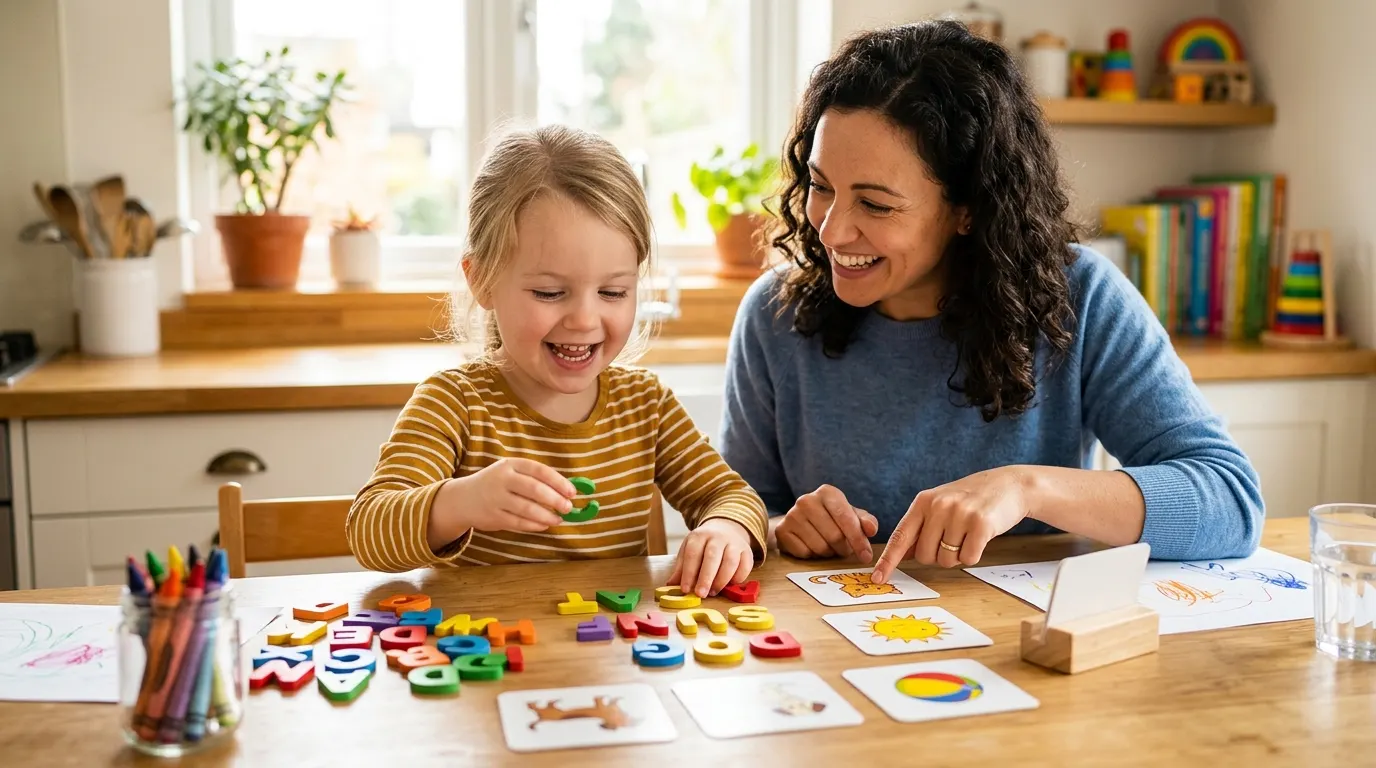
Game night just got a lot smarter. If you're looking for ways to sneak some learning into family time without anyone noticing, educational board games for kids are honestly one of the best tricks in the parenting playbook.
This post contains affiliate links. We may earn a small commission at no extra cost to you. TL;DR: The best educational board games for kids include Zingo for early readers, Sum Swamp for math skills, Blokus for spatial thinking, and Rory's Story Cubes for creativity and language. All of them feel like pure fun — the learning happens without anyone realizing it.Whether your child is 3 and just starting to recognize letters or 10 and ready for strategy, there's a game that fits. And unlike screen time, a good board game builds focus, teaches turn-taking, and gets the whole family off their phones.
Why Board Games Beat Apps for Learning
There's a reason teachers and child development experts keep recommending tabletop learning games over digital alternatives. Physical play engages the brain differently.
The Social Skills Bonus
Playing a game with another person — winning, losing, waiting your turn — builds a skill set no app can fully replicate. Board games teach kids how to handle real emotions in a low-stakes setting, and that's genuinely valuable.
Research from the American Academy of Pediatrics shows that hands-on, cooperative play builds executive function in children far more effectively than passive digital experiences. So yes, game night actually counts as development time.
Best Educational Board Games for Ages 3–5
This age group needs fast rounds, simple rules, and big, satisfying wins. The games below check all three boxes.
Zingo: The Early Reading Favorite
Zingo is a bingo-style game that matches words to pictures. It's fast-paced enough to hold a 3-year-old's attention, and before you know it, they're recognizing sight words without any "official" studying. Get a Zingo Word Bingo set — it's consistently one of the most-recommended kindergarten prep games out there.
Sequence for Kids: Patterns and Strategy
This is a simplified version of the classic Sequence game. Kids match animal cards to spaces on the board, building sequences. It quietly builds pattern recognition and visual tracking with every single turn, with almost no effort on your part.
Best Educational Board Games for Ages 6–9
By this age, kids can handle a little more complexity — and they love the satisfaction of a real challenge.
Sum Swamp: Making Math Tactile
Sum Swamp is brilliant for building addition and subtraction skills in kids ages 5–8. Players roll dice and navigate a swamp by solving simple math problems. It's not flashy, but kids who play it regularly genuinely get faster at mental math. A Sum Swamp math board game makes a wonderful birthday gift that parents secretly love giving.
Blokus: The Spatial Reasoning Champion
Don't let the simple rules fool you — Blokus is deceptively strategic. Players take turns placing colored pieces on the board, with each piece touching a corner of another piece of the same color. It builds spatial reasoning, geometry thinking, and tactical planning. It's also genuinely fun for adults, which means this one actually gets played.
Best Educational Board Games for Ages 10+
At this stage, learning games can go deep. These picks reward kids who are ready to think more critically.
Forbidden Island: Cooperation Over Competition
Sometimes the best lesson is that winning together beats losing alone. Forbidden Island is a fully cooperative game where players work as a team to collect treasures before the island sinks. Kids learn communication, shared decision-making, and how to stay calm under pressure. There's no "winner takes all" — you either all succeed or all go down together.
Rory's Story Cubes: Creativity Meets Vocabulary
These little dice have tiny pictures on each face. Roll them, then build a story from whatever comes up. It's endlessly replayable, brilliantly simple, and incredible for language development and creative thinking. Grab a Rory's Story Cubes set for car rides, waiting rooms, or any time you want five minutes of genuine conversation with your kid.
How to Turn Game Night Into a Learning Habit
The best learning routines are the ones kids actually look forward to. You don't need to make it formal or fancy.
The "Friday Game" Routine
Set a recurring game night — even just 20–30 minutes — and let your child pick the game from a short rotation of three or four options. Giving them ownership makes it feel less like homework and more like a treat.
You don't need a huge collection. Four to six well-chosen games gives enough variety to stay fresh without overwhelming anyone. And as your child grows, swap in more challenging learning games to keep pace.
Pairing game night with a regular read-aloud routine is a powerful combination — both build language skills in complementary ways.
For digital supplements (not replacements), Khan Academy Kids is free and covers many of the same skills these learning games build. It's a solid option for reinforcing concepts between game nights.
FAQ
What are the best educational board games for 5-year-olds?
For 5-year-olds, Zingo and Sequence for Kids are excellent choices. They reinforce early reading and pattern recognition without requiring kids to read long instructions or track complex rules. Rounds are short, which suits their attention spans perfectly.
Can board games really help with school performance?
Yes — the research backs it up. Games that involve strategy, language, or math concepts reinforce the same skills children are developing in school, but in a low-pressure, playful context. Regular game play has been linked to stronger working memory and problem-solving in young children.
How many board games does my family actually need?
Honestly? Four to six is plenty. One for very young kids, one cooperative game, one language and creativity game, and one strategy game covers most bases. A great game that gets played every week is worth far more than a shelf full of dusty boxes.