Looking for a simple, screen-free activity that can captivate your child's attention while secretly building their brainpower? Welcome to the wonderful world of origami! This ancient Japanese art of paper folding is the perfect blend of creativity, concentration, and fun. With just a few sheets of paper, you can create a whole universe of animals, shapes, and toys.
This post contains affiliate links. We may earn a small commission at no extra cost to you. Quick Answer: The easiest origami projects for kids are the classic paper cup, a simple dog or cat face, and the fortune teller (cootie catcher). These projects use basic folds, are easy to memorize, and give kids a fun, functional object they can play with immediately after folding. It's a fantastic activity for developing fine motor skills.The Amazing Benefits of Origami for Kids
Before we get to folding, let's appreciate why this is such a powerful activity for developing minds. Origami is more than just a craft; it's a hands-on lesson in geometry, a practice in mindfulness, and a great way to improve dexterity. According to a study highlighted by the National Library of Medicine, activities like origami can significantly improve children's fine motor skills and hand-eye coordination.
Here are a few key benefits:
- Builds Concentration: Following step-by-step instructions requires focus.
- Improves Spatial Reasoning: Kids learn to visualize and manipulate 2D shapes into 3D objects.
- Encourages Patience and Resilience: Not every fold will be perfect the first time, and that's a great lesson!
- Boosts Confidence: Successfully creating a finished object provides a huge sense of accomplishment.
Getting Started: All You Need is Paper!
You don't need fancy equipment to start. While you can buy special, colorful origami paper like this 100-pack of vibrant colors on Amazon, you can also just cut any regular printer paper into a perfect square.
How to make a perfect square from rectangular paper:- Take one corner and fold it down to meet the opposite edge, forming a triangle.
- You'll have a rectangular strip of paper left over at the bottom.
- Cut off that strip.
- Unfold the triangle, and you have a perfect square!
Three Super Simple Origami Projects for Beginners
Let's start with some easy wins! These projects are perfect for little hands and short attention spans.
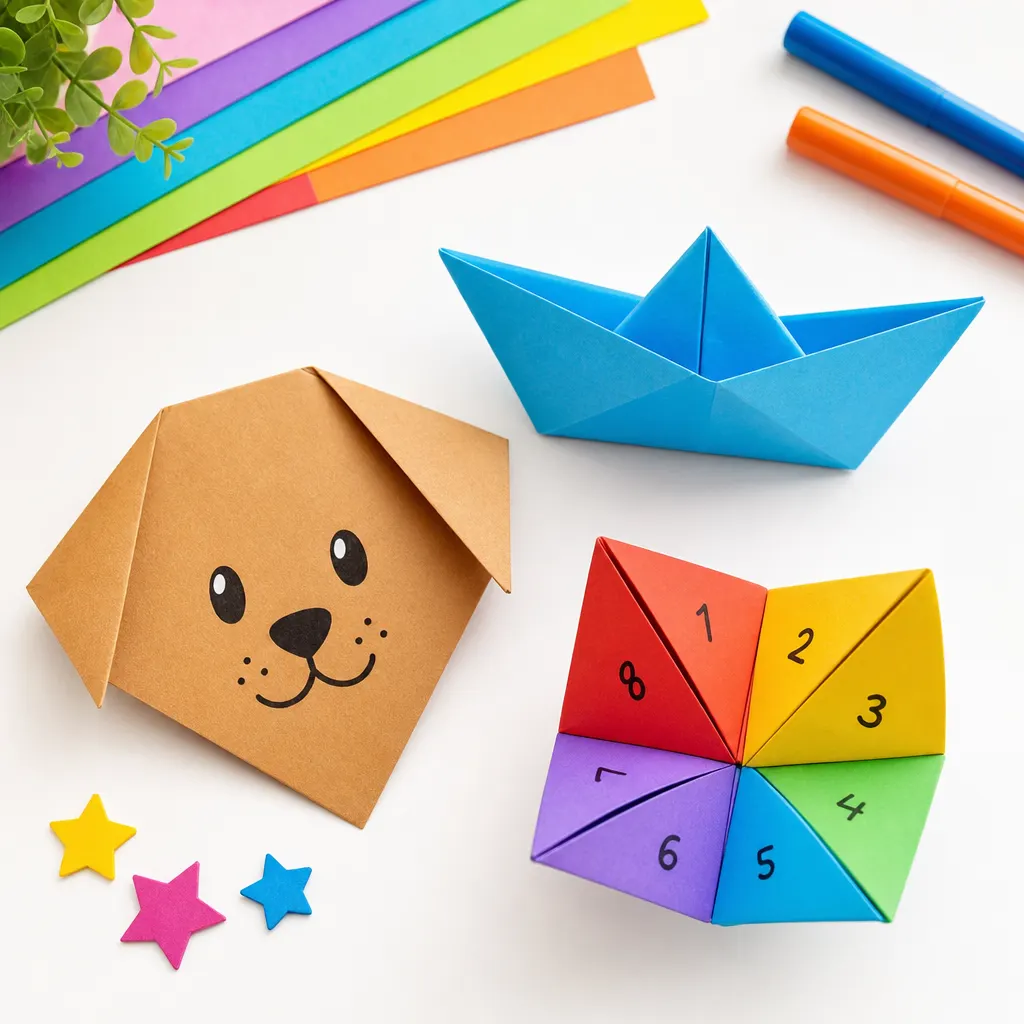
1. The Classic Dog Face
This is a favorite for a reason! It's adorable and only takes a few simple folds.
- Start with your square of paper.
- Fold it in half diagonally to make a triangle.
- Position the triangle with the long edge at the top and the point facing down.
- Fold the left and right corners down to create floppy ears.
- Fold the bottom point up just a tiny bit to make the chin.
- Use markers to draw a nose, eyes, and whiskers!
2. The Jumping Frog
An origami creation that actually does something? Yes, please!
- Start with a rectangular piece of paper (a half-sheet of printer paper works well).
- Fold it in half lengthwise.
- Follow a simple video tutorial like this one from Go Origami for the trickier folds.
- Once finished, press down on its back and watch it leap! You can even have frog races.
3. The Fortune Teller (Cootie Catcher)
A playground classic that never gets old. This one is great for practicing dexterity and can be filled with fun fortunes or activities. A good set of washable markers makes decorating it even more fun.
FAQ: Your Origami Questions Answered
What age is best to start origami?
Around ages 5 or 6 is a great time to introduce simple origami. They have the fine motor skills to make basic folds and the ability to follow simple instructions. But even younger toddlers can enjoy crumpling and folding paper with you.
My child is getting frustrated. What should I do?
Take a break! Choose a simpler project or just have fun folding the paper in random ways. The goal is to have fun, not achieve perfection. It also helps if you sit alongside them and make your own, modeling that it's okay to make mistakes and refold.
Where can I find more patterns?
There are tons of free resources online! Websites like Origami.me and the Origami Way have huge libraries of patterns for all skill levels. Books are also a fantastic, screen-free way to learn.
Happy folding!