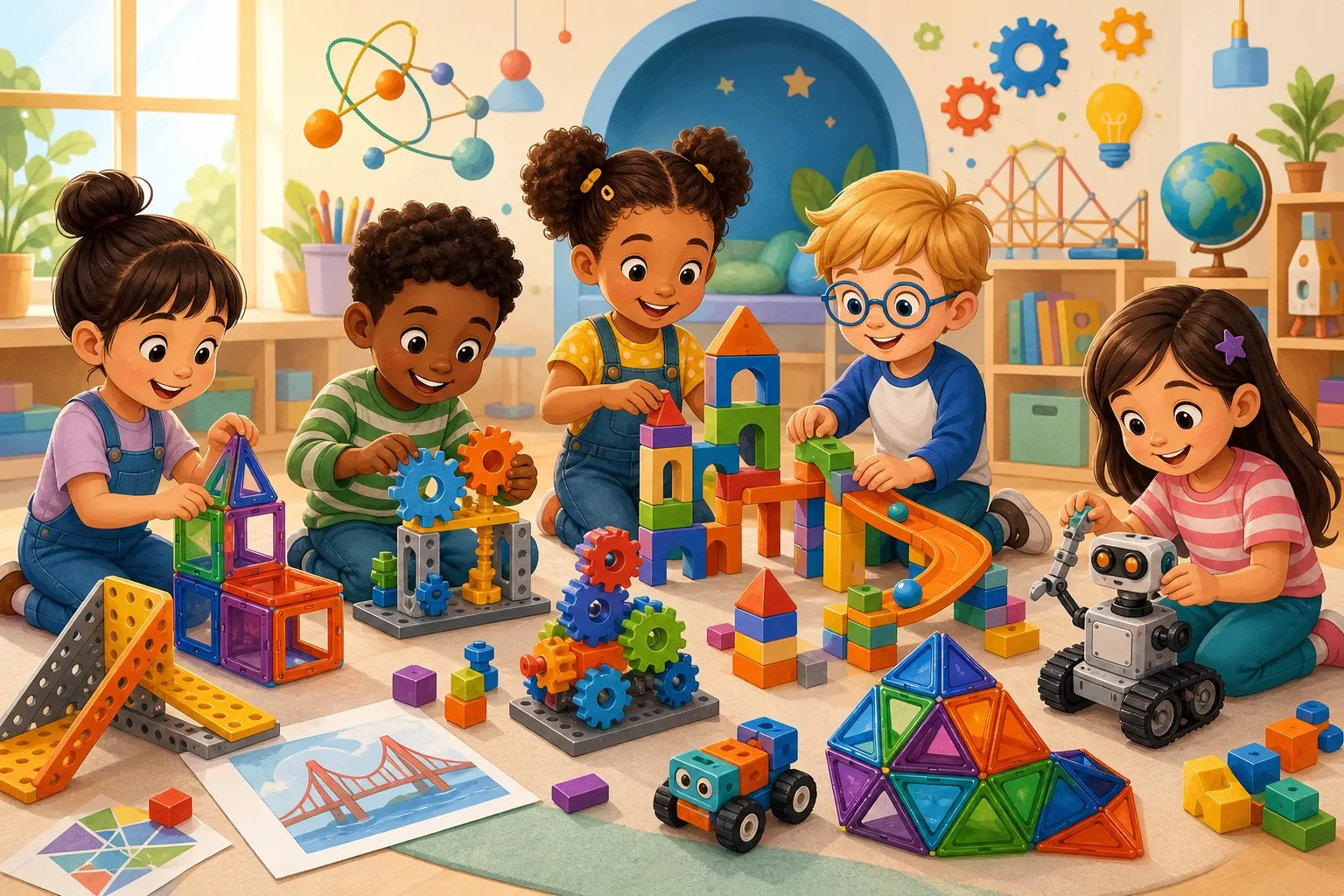
The toy aisle is full of promises. But most of what ends up in your cart gets played with once and forgotten by Tuesday. STEM building toys are the exception — the good ones get pulled out again and again, and kids don't even realize they're learning while they play.
This post contains affiliate links. We may earn a small commission at no extra cost to you. TL;DR: The best STEM building toys for kids ages 4–8 are Magna-Tiles (open-ended, grows with them), LEGO Classic sets (creativity + fine motor), Snap Circuits (real electronics, no batteries needed to understand), and KiwiCo kits (monthly surprises that feel like a project, not homework). All four offer serious hands-on learning with zero boredom.Whether your child is 4 and obsessed with towers or 8 and ready for circuits, there's a construction toy that fits exactly where they are right now.
Why STEM Toys Matter More Than You Think
Play is how kids learn. That's not a parenting cliché — it's backed by decades of research. The National Association for the Education of Young Children (NAEYC) has long emphasized that play-based learning is one of the most powerful ways young children build cognitive, social, and problem-solving skills.
STEM building toys tap directly into that. When a child stacks magnetic tiles and watches a tower collapse, they've just run a physics experiment. When they follow a LEGO instruction sheet, they're reading technical diagrams and practicing spatial reasoning. The learning is invisible to them — and that's exactly what makes it stick.
What Makes a Good STEM Toy
Not every toy with "educational" on the box earns the label. Look for these three things:
- Open-ended potential — can the toy be used in more than one way?
- Appropriate challenge — frustrating is fine; impossible isn't
- Replayability — will it come back out after the first week?
If a toy meets all three, it's worth the shelf space.
Best STEM Building Toys for Ages 4–6
Younger kids need big pieces, satisfying feedback (something clicking or sticking feels great), and the freedom to build wrong and be totally fine with that.
Starter Picks for Preschoolers
Magna-Tiles Classic 32-Piece Set is consistently the first recommendation from early childhood educators — and for good reason. The magnetic edges click together satisfyingly, the pieces are colorful and translucent (hold them up to light for instant wonder), and there's no wrong way to build. A 4-year-old can make a flat mosaic. A 7-year-old can engineer a house with a roof that stays up.They're pricier than a box of blocks, but they genuinely grow with your child for years. Worth every penny for the longevity alone.
LEGO Classic Creative Brick Box is the other workhorse. At this age, skip the complicated licensed sets (the instructions become the point, which misses the learning value). Classic sets give a pile of bricks and say "go." That's where the real creativity lives.Start simple, stay loose, and follow their lead.
Best STEM Building Toys for Ages 6–8
Older kids are ready for more structure — not rigid structure, but projects with a beginning, middle, and satisfying end. They want to make something that actually does something.
Level Up for Curious Grade-Schoolers
Snap Circuits Jr. is one of the most underrated toys in the STEM space. It teaches real electronics — working circuits that light up, buzz, and spin — using color-coded snap pieces that connect like Lego blocks. No soldering. No loose wires. No dad hovering anxiously.The kit includes a project book with over 100 experiments, organized by difficulty. Kids can build a doorbell, an alarm, or a simple radio. Each success feels enormous. It's the perfect bridge between "I like building stuff" and "I want to understand how things work."
For kids who love the idea of getting a surprise project in the mail every month, KiwiCo is genuinely excellent. Their Koala Crate (ages 3–4) and Kiwi Crate (ages 5–8) deliver hands-on science and art projects with all the materials included. The projects are designed by educators, tested by kids, and arrive feeling like a gift — not a homework assignment.
It's a subscription, so it's an ongoing cost, but for kids who go through activity phases quickly, it keeps the momentum going without you having to think about it.
How to Choose the Right STEM Toy
The age suggestions on boxes are more like guidelines than rules. What matters more is your child's current interest and frustration tolerance.
A 5-year-old who loves "making things go" might be ready for Snap Circuits. A 7-year-old who still loves sensory, open-ended play will get more from Magna-Tiles than a structured kit. Watch what they gravitate to rather than buying for the number on the box.
Match Difficulty to Your Child's Current Interest
A good rule of thumb: find what they already love and extend it one step.
- Love drawing and making? → Art + STEM kits from KiwiCo
- Love knocking things down? → Magna-Tiles or building blocks
- Love asking "why does that work?" → Snap Circuits or a basic coding toy
You can also pair physical STEM toys with hands-on activities you do at home. For a great next step once the building bug kicks in, try some of the easy science experiments kids can do at home — they use kitchen supplies and cost almost nothing.
The Bottom Line
The best STEM building toys don't lecture. They invite. They put something interesting in a child's hands and get out of the way.
Start with open-ended sets for younger kids, add complexity as they're ready, and don't stress about whether they're "learning the right things." If they're building, experimenting, and coming back for more — the learning is happening.
That's the whole point.
---
FAQ
What age should kids start with STEM toys?
As early as 18 months, with large, safe stacking blocks. Most dedicated STEM building toys — like Magna-Tiles and LEGO Duplo — are well-suited from ages 3–4 onward, with more complex sets appropriate from ages 5–6.
Are expensive STEM toys worth the money?
Often, yes — but not always. Magna-Tiles and Snap Circuits are worth the premium because they have long lifespans and genuine educational value. Cheaper sets can be great too. Look for open-ended replayability, not just a high price tag.
How much time should kids spend with STEM toys vs. screens?
There's no magic number. The American Academy of Pediatrics recommends limiting recreational screen time for ages 2–5 to 1 hour per day with high-quality content, but for school-age kids, it's more about balance and co-viewing when possible. STEM toys are a natural, engaging screen-free alternative — especially if you sit down and build alongside them for even 10 minutes.