The school bags are tossed aside, the weather is warm, and the long, lazy days of summer are here. While it's a well-deserved break, many parents worry about the "summer slide," especially when it comes to math. But keeping those numbers skills sharp doesn't mean forcing worksheets and flashcards.
This post contains affiliate links. We may earn a small commission at no extra cost to you. Quick answer: To stop the summer math slide, integrate simple, playful math activities into your daily routine. Focus on real-world connections like cooking, shopping, or playing board games. The goal is to make math a natural part of summer fun, not a chore that interrupts it.By weaving numbers into everyday adventures, you can prevent learning loss and show your kids that math is more than just a school subject—it's a tool for exploring the world.
1. Cook and Bake Together
The kitchen is a fantastic, and tasty, math laboratory. Following a recipe involves all sorts of essential skills.
Measure Everything
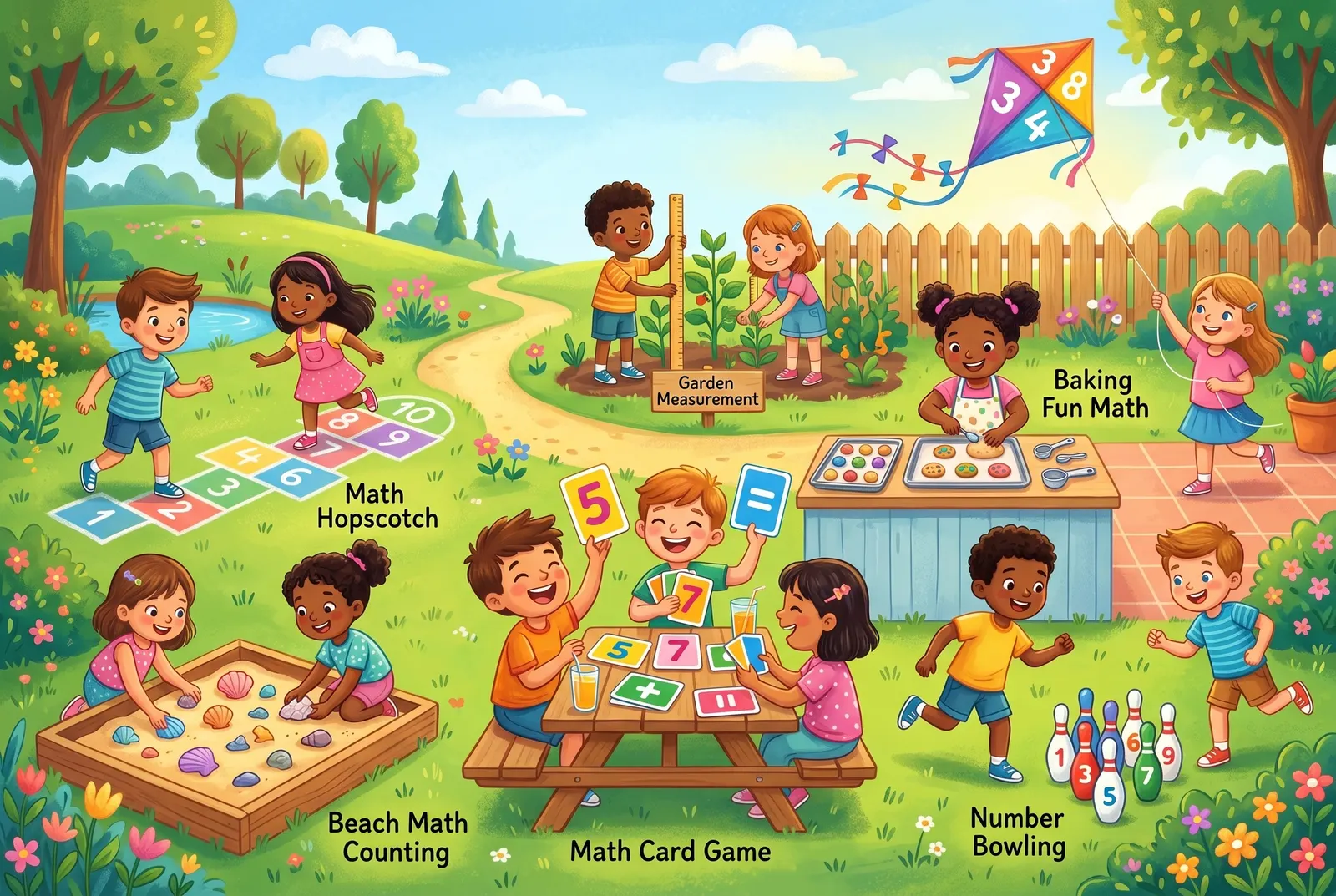
Let your kids be in charge of measuring ingredients. This teaches fractions (1/2 cup, 3/4 teaspoon) in a tangible way. Doubling a recipe or halving it introduces multiplication and division. A simple digital kitchen scale can also introduce concepts of weight and conversion (ounces to grams).
Talk About Time
Set timers, calculate cooking times, and figure out what time dinner will be ready. This reinforces addition, subtraction, and understanding the concept of time.
2. Take Math Outside
Use the great outdoors as your chalkboard. All you need is a bucket of sidewalk chalk and a little imagination.
Sidewalk Sudoku and Number Lines
Draw a giant number line and have kids hop to the answer of simple math problems. Create a life-sized "chutes and ladders" game board. For older kids, drawing out a giant Sudoku puzzle can be a fun collaborative challenge.
3. Play Games, Not Drills
Board games and card games are packed with learning opportunities. They teach counting, probability, strategy, and recognizing patterns without ever feeling like "work."
Classic and New Favorites
Games like Monopoly teach money management. Chutes and Ladders reinforces counting. For something more focused, a game like Proof! Math Game is a fast-paced and fun way to practice mental math. For more ideas, check out our list of fun math games you can play at home.
4. Turn Errands into Math Missions
Your regular trip to the grocery store is a goldmine for real-world math.
The Estimation Game
Before you go, have your kids estimate the total cost of the items on your list. In the store, have them weigh produce, compare prices per unit, and calculate the change you'll get back. It’s a practical lesson in budgeting and decimals.
5. Build and Create
Whether it's a LEGO masterpiece or a pillow fort, building involves geometry, spatial reasoning, and problem-solving. Ask questions like, "How many blocks tall is your tower?" or "What shape should we make the door to the fort?" This helps them connect mathematical language to their creations.
6. Explore Patterns in Nature
Math is everywhere in the natural world. Go on a "pattern hunt" in your backyard or a local park. Look for symmetry in leaves, count the petals on different flowers, and spot geometric shapes in spiderwebs. This helps children see that math isn't just an abstract concept; it's the language of the universe. For more on this, the Johns Hopkins School of Education has great insights into preventing summer slide with real-world learning.
7. Read Math-Themed Storybooks
Who says story time can't include a little math? There are tons of wonderful picture books that playfully introduce mathematical concepts, from counting and shapes to more complex ideas. Reading stories about math makes the subject more approachable and less intimidating for kids who might feel anxious about it.
By making math a part of your summer adventures, you're not just preventing the summer slide. You're fostering a positive, curious, and confident relationship with numbers that will set your child up for success long after the school bell rings again.
FAQ
H3: My child says math is boring. How can I change their mind?
The key is to connect math to their interests. If they love LEGOs, focus on building. If they love art, explore patterns and shapes. When math is a tool to do something they already enjoy, it stops being "boring" and becomes part of the fun.
H3: At what age should I start doing these activities?
You can start at any age! A toddler can help you count out apple slices, while an older child can help you calculate the cost of groceries. The activities can be easily adapted to your child's developmental level. The goal is exposure and positive association, not mastery.
H3: How much time should we spend on this each day?
Don't schedule it. The beauty of this approach is that it's not about dedicated "math time." It's about weaving it into things you're already doing. A few minutes here and there while you cook, shop, or play is all it takes to keep their brains engaged.