Preschool engineering activities do not need tiny tool belts, complicated kits, or a parent with an engineering degree. They just need a question kids can test: Can we make it taller? Can we make it roll? Can we keep it from falling?
This post contains affiliate links. We may earn a small commission at no extra cost to you. TL;DR: The best preschool engineering activities use everyday materials like blocks, paper cups, cardboard tubes, tape, and recycled boxes. Start with short build challenges, ask open-ended questions, and let kids revise their designs. The learning happens when the tower tips, the ramp fails, and your child gets to try again.Engineering for preschoolers is really structured play. Children plan, build, notice what happened, and change something. That cycle builds persistence, early science thinking, fine motor strength, and language. It also turns a slow afternoon into something that feels fresh without needing a screen.
Start With Build Challenges, Not Instructions
Preschoolers usually do better with a challenge than a step-by-step craft. A craft asks them to copy. An engineering challenge asks them to solve.
Try prompts like:
- Build a tower as tall as your knee.
- Make a bridge that can hold three toy cars.
- Build a house for a small stuffed animal.
- Make a ramp that sends a ball into a box.
- Create a boat that can hold ten pennies.
Keep the first round short. Ten to fifteen minutes is plenty for younger kids. If they want to keep going, great. If they wander off, leave the materials out and let them return later.
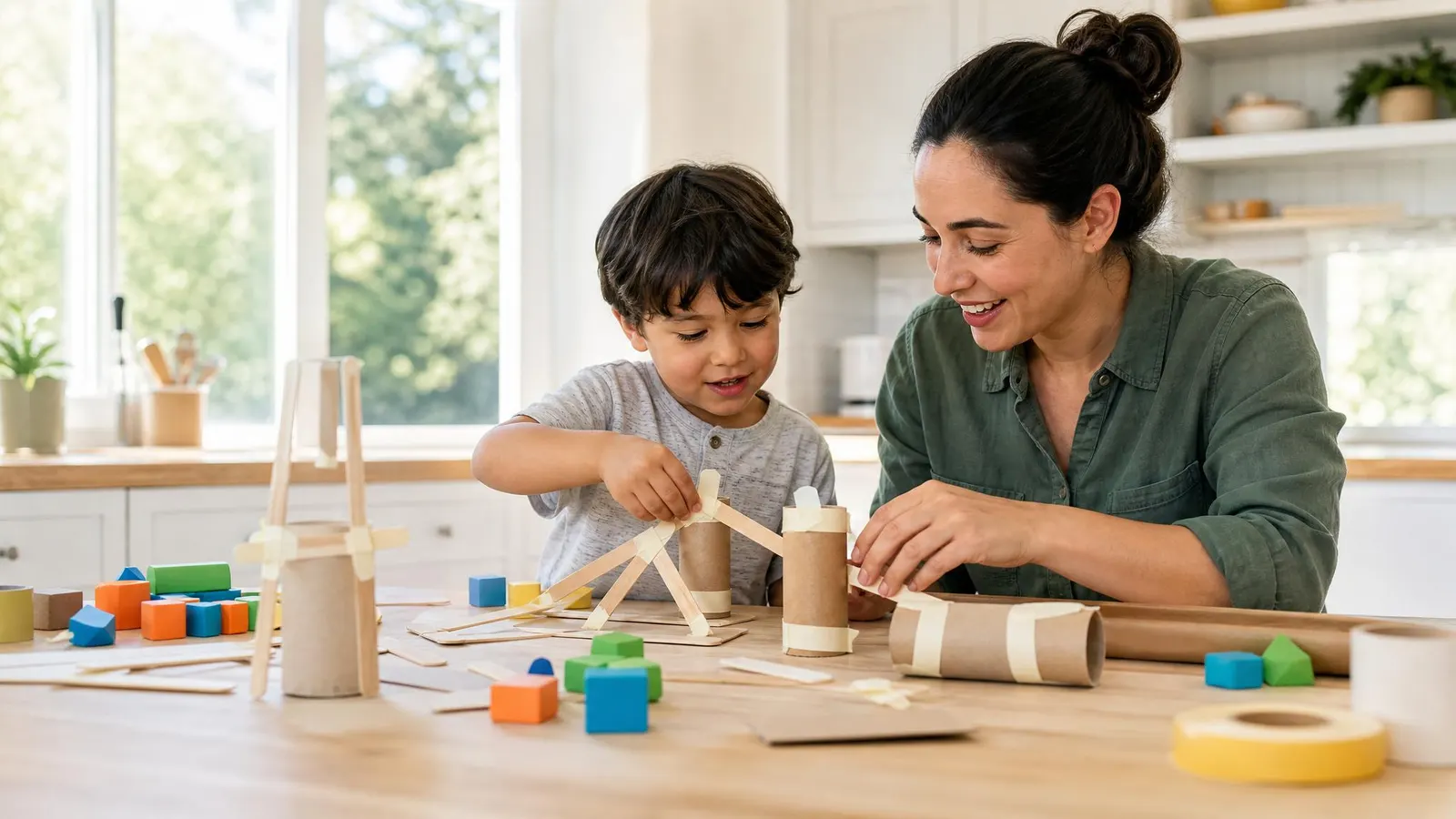
For materials, start with what you already own: blocks, paper towel tubes, cereal boxes, plastic cups, cardboard, string, and washable tape. If you want a simple STEM bin, add wood craft sticks, painter's tape, and a few lightweight balls.
Build Towers, Bridges, and Ramps
These three categories cover most early engineering skills and are easy to repeat without feeling stale.
Tower builds teach balance and stability. Invite your child to compare wide bases and skinny bases. Ask, "What happens if the heavy blocks go on top?" Then let the tower answer.
Bridge builds teach span, support, and strength. Put two stacks of books a few inches apart and ask your child to connect them. Cardboard may sag. Craft sticks may slide. Blocks may make a sturdy path. Add a toy animal or car as the "test weight."
Ramp builds teach motion and cause-and-effect. Use a baking sheet, cardboard, or a board propped on a couch cushion. Change one thing at a time: height, surface, ball size, or target distance. This pairs nicely with more kitchen science experiments for kids because both help children notice patterns instead of just watching a result.
The trick is to resist fixing everything. If the bridge collapses, say, "What could make it stronger?" If the ramp misses the target, ask, "Should we move the box or change the ramp?"
Use Recycled Materials for Big Imagination
Recycled materials are perfect for preschool engineering because they are lightweight, cheap, and low-pressure. A box can become a parking garage, a robot, a marble run, or a doll elevator.
Good recycled materials include:
- Cardboard boxes in different sizes
- Paper towel and toilet paper tubes
- Egg cartons
- Plastic lids
- Clean yogurt cups
- Cereal boxes
- Packing paper
Set out only a few materials at a time. Too many choices can make the activity messy before it becomes creative. A simple tray with cardboard tubes, tape, and paper cups is enough for a full build session.
For kids who love vehicles, try a delivery challenge: build a path that moves a cotton ball from one side of the table to the other. For animal-loving kids, build a zoo habitat with tunnels, fences, and shade. For art-focused kids, let them decorate after the structure works.
Ask Better Questions While They Build
The language you use can make preschool engineering feel more like discovery and less like a performance.
Try questions that invite thinking:
- What is your plan?
- What part feels wobbly?
- What could we change?
- How will you test it?
- What happened that surprised you?
Avoid turning every build into a lesson. You do not need to define "load-bearing" or "incline" unless your child asks. Simple words work: strong, wobbly, steep, flat, heavy, light, tall, short, faster, slower.
The National Association for the Education of Young Children notes that young children learn STEM best through active exploration, conversation, and play. Their parent-friendly resources at NAEYC are a useful reminder that preschool learning should feel hands-on and social, not like a worksheet squeezed into playtime.
If your child gets frustrated, model one small reset: "This design did not work yet. Let's change one thing." That tiny word, "yet," is powerful.
Simple Supplies Worth Keeping Around
You do not need many tools, but a small engineering basket makes these activities easier to start.
Helpful supplies include magnetic building tiles, craft sticks, masking or painter's tape, clothespins, paper cups, child-safe scissors, string, and washable markers. A simple wooden block set is also hard to beat because blocks can become towers, bridges, ramps, cities, and obstacle courses.
Store everything in one bin so setup takes less than two minutes. Preschool activities are more likely to happen when the parent barrier is low.
FAQ
What age can kids start preschool engineering activities?
Many children can start around age 3 with simple stacking, ramp, and bridge challenges. Keep materials large, avoid choking hazards, and focus on exploration rather than a finished product.
Do preschoolers need STEM kits?
No. STEM kits can be fun, but cardboard, cups, blocks, and tape are enough for meaningful engineering play. Everyday materials often lead to more creative problem-solving because there is no single "right" build.
How do I keep engineering activities from becoming chaotic?
Limit materials, set a clear challenge, and use a tray or table boundary. Start with 10 minutes and clean up together before adding new supplies. Small constraints usually make the play better, not worse.