A funny thing happens around age 5 or 6: kids start reading. And then a lot of parents stop reading aloud, assuming the job is done. It isn't. Read-aloud is actually more important once kids are early readers — but the strategies need to change. The all-cozy-bedtime-story routine that worked at age 3 doesn't quite fit a child who's now sounding out words on their own.
This post contains affiliate links. We may earn a small commission at no extra cost to you. TL;DR: Keep reading aloud well past the point your child can read by themselves. The job changes: now you're modeling fluency, expanding vocabulary above their reading level, and showing them that stories are the prize — not the act of decoding. Aim for 15–20 minutes a day. Trade-off reading roles ("I'll read this page, you read the next"). Pick books at least one year ahead of what they can independently read.This is the post I wish someone had handed me when my own kids were 5 and 7 and I caught myself thinking "okay, they can read, my work here is done." It very much wasn't.
Why Read-Aloud Matters Even More Now
When a child is decoding a word — sounding it out letter by letter — almost all of their brain's capacity is on that mechanical task. There's very little left for meaning, expression, or enjoyment. That's exhausting. It's also why a lot of early readers, especially boys, start to act like they hate reading right around grade 1. They don't hate reading; they hate how hard it is.
When you read aloud to them, that decoding cost is on you. The child gets to experience what reading is for — the story, the joke, the cliffhanger. They get to hear what fluent reading sounds like. And — this is the underrated part — they hear vocabulary and sentence structures well above their own reading level, which is one of the strongest predictors of long-term reading comprehension.
For more on protecting the joy of reading at this age, see raising readers without screens.
Five Strategies That Actually Work
1. Read above their independent reading level
If your child can comfortably read Frog and Toad on their own, read aloud from The Mouse and the Motorcycle, Charlotte's Web, Mr. Popper's Penguins. The vocabulary, sentence structure, and emotional complexity should be at least a year — ideally two — beyond what they can decode themselves. This is where the "ear vocabulary" that fuels later reading comprehension comes from.
2. The "I'll read, you read" rotation
Once your child has a foothold in reading, alternate. You read a page (or a paragraph), they read a page. Two big benefits: they get to practice without it being a 20-minute slog, and they hear your fluent reading right next to their own halting reading, which is the fastest way to internalize what fluency sounds like.
A small caution: never use this to "check" their reading. The moment it turns into a quiz, the magic evaporates. If they get a word wrong, supply it gently and keep moving.
3. Read books they picked, even the bad ones
Give your early reader real say in what you read aloud, even when their choices baffle you. A capybara joke book. A Pokémon encyclopedia. A graphic novel about farts. The choosing itself builds the muscle of being a reader who has preferences, which matters more at this age than the literary quality of any individual book.
There are good ones to seed the menu — our best chapter books for early readers post has solid candidates. But the kid's own picks belong in the rotation too.
4. Stop on the cliffhanger, not at chapter end
The single most underrated trick. Don't finish the chapter. Stop mid-scene, when something is about to happen. This creates a felt sense that the story continues without us, that we're returning to a world tomorrow. It's the same hook that makes serialized TV work, and it's why kids who read short, complete stories every night don't develop the same momentum as kids who get cliff-hung.
5. Read in voices, but don't perform
You don't have to be a voice actor. But some variation — the giant gets a low voice, the mouse gets a squeaky one — does two things. It teaches that punctuation maps to expression (the exclamation point is loud!). And it makes the read-aloud feel like a shared performance rather than a parent chore.
If you genuinely can't do voices, just slow down at dialogue and speed up during action. That's enough.
The Setup That Removes Friction
Read-aloud succeeds or fails on whether it's easier than the alternatives. A few small environmental moves:
- A reading basket within reach of where you usually settle. Five books at a time, rotated weekly. Decision fatigue kills daily reading more than time scarcity.
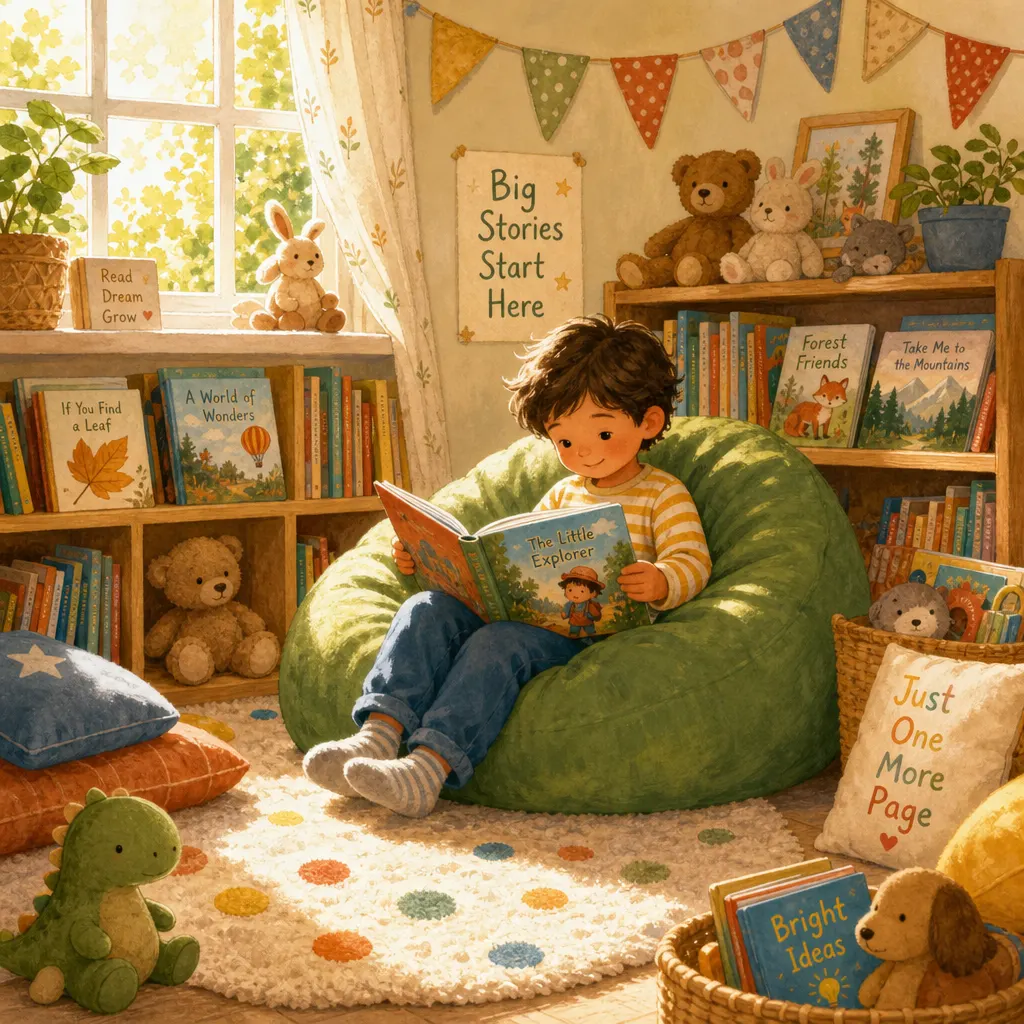
- A simple, comfy spot. Doesn't need to be a curated reading nook — a corner of the couch and a soft pillow is fine.
- Warm, glare-free light. A small lamp on a timer that turns on at "wind-down time" cues the routine without you announcing it.
- No phones in arm's reach. Yours or theirs. If your phone is on the cushion, the read-aloud loses every time.
For families with multiple kids of different ages, a decent kids' tablet with audiobooks helps the older sibling listen along during a younger sibling's read-aloud. Not a replacement for the parent's voice — a supplement. Audiobook narration during car rides or quiet time keeps the "story-listening" muscle warm; see our educational apps post for the broader app context.
What to Do When They Want to Read to You
Around age 6–7, most kids hit a phase where they want to read to you, with a kind of new pride. Lean in, but with a couple of guardrails:
- Let them pick a book one or two levels below their max. They want to look fluent; let them. The growth happens in shared and stretch reading.
- Don't correct every error. Pick one or two key mispronunciations per session if any. The goal is confidence, not accuracy.
- End on a high note. If they're tiring, finish the sentence yourself ("...and then she opened the door — I'll take this part") so the session ends with a feeling of progress, not struggle.
A few simple creative storytelling prompts at the end of a read-aloud can pivot a sleepy-listening session into a goofy invent-the-next-chapter session, which is another way to build the "story-shaped thinking" reading is really for.
Handling the Resistant Reader
Some kids — often, but not only, kids with reading difficulties — go through a year where they actively resist read-aloud. A few things that help:
- Drop the bedtime slot. Try right after school instead, or while they're eating breakfast. The bedtime window is overloaded.
- Drop "books," temporarily. Read comic books, recipe instructions, video game manuals, baseball cards. The medium matters less than the practice of decoding meaning together.
- Skip a few days. Forcing read-aloud through resistance creates a bad association you'll pay for later. Three days off and a fresh, highly interesting book usually resets things.
If resistance persists for months, or comes with frustration around school reading, it's worth a chat with the school's reading specialist. Some kids who "hate reading" actually have a specific learning difference that's masked until 2nd or 3rd grade.
FAQ
Q: At what age should I stop reading aloud?Whenever your child stops wanting it. For many families, that's 10 or 11. For some, it's never — there are families where read-aloud continues into early teens for serious novels. The benefit doesn't expire; the format may shift to shared audiobooks or alternating chapters.
Q: How long per session?15–20 minutes is plenty for a 5–7 year old. 20–30 for older kids. Quality over duration — five engaged minutes beats twenty distracted ones.
Q: My child wants the same book every night. Is that okay?Yes, and it's actively good. Repetition builds fluency, vocabulary, and prediction. Read it joyfully until they ask for something new. (Hide the book briefly if you genuinely cannot do Goodnight Moon one more time.)
Q: Are audiobooks a fair substitute when I'm tired?A supplement, not a substitute. Audiobooks build listening comprehension and vocabulary nicely. They don't build the connection of a parent reading aloud, which is doing emotional work in addition to literacy work. Use them on car rides; keep at least a few nights of in-person reading per week.
Q: My partner and I read in totally different styles. Is that confusing?The opposite — it's great. Different voices, different paces, different favorite books. Your child gets a richer model of what reading looks like.
---
The point of reading aloud to an early reader isn't to teach them to read — they're already learning. It's to keep alive the reason anyone reads in the first place: that stories are worth the work. Pick a book a year above their level, sit close, stop on a cliffhanger, and you'll buy yourself another decade of a kid who reaches for books.